

How to maintain a focused mind in Iaido
The Role of Zanshin:
Mokuso at the start and finish of iaido training is more than a pause before and after training. It is the quiet threshold where everyday mind is set down and the mind of practice is picked up, then later, where the breath of the dōjō is gently returned to daily life. In that short span of silence, we remember why we train, how we wish to stand in the world, and what kind of heart we want behind each cut.
The Role of Zanshin
The natural appeal of sword arts, particularly Iai (居合), is the idea that someone in the modern era can learn, in a sense, what it meant to be a warrior in medieval times and experience the romantic symbolism surrounding these weapons and the people who carried them. It is rare to cultivate what many would describe as a “warriors spirit”, in todays society. The opportunity to embody that spirit through disciplined practice inspires feelings of gratitude.
In short, swords are fascinating to study, enjoyable to swing, and deeply captivating. For many people, that excitement is what first draws them into the practice of Iai. It’s a welcome culture shock when first stepping into an Iai dojo. While this initial appeal helps spark interest, Homonji – along with many other traditional schools of Budo, (武道), – “the martial way”-strives to refine that fascination over time. Through disciplined training, the ego gradually gives way to a calmer and more attentive state of mind. The sword becomes less about fantasy and more about self-cultivation.
This is where Zanshin (残心) becomes essential. Rather than being a single technique or isolated concept, Zanshin represents the culmination of our training. It exists as an essential part of Iai, while also serving as a mindset that we strive to carry with us, both inside and outside the dojo.
What Zanshin Is
Zanshin (残心) is commonly translated as “Lingering Awareness” or Remaining Mind.” The first character Zan (残), means to remain or to continue. The second character, Shin (心), means heart, mind, or spirit. Together, they express the idea of complete awareness that continues after an action has ended. Zanshin is the cultivation of total presence in both thought and action. It is the ability to be mentally awake without allowing the mind become distracted, fixated, or absent during the transition from action to inaction. The awareness does not end once the action has concluded.
When we describe how Zanshin is applied, there are two primary vehicles through which it’s understood: Zanshin through technique and Zanshin through philosophy. Zanshin through technique refers to the to the practical application of lingering/remaining awareness during the physical performance of Iai. Zanshin through philosophy describes how Iaidoka (居合道家)- Iai students – cultivate this same awareness as a way of understanding the broader impact that Iai has on the individual and, ultimately, on humanity. Together these two perspectives result in a balance between movement and stillness, action and non-action, allowing the mind to stay steady regardless of the circumstance.
Zanshin Through Technique
Zanshin through technique is relatively straightforward. During performance, its application is understood as the echo after our actions. Zanshin begins at the conclusion of our action (as in kata), however it is not truly the end. It begins with a pause. Our enemy, aka Teki (敵) is defeated or the immediate danger has ended. But our mind, like our sword is sharp and present.
This pause that occurs, although for only a brief moment, is the difference between a performance, and repetition. The idea of a Iai performance is that anyone who watches should be able to see exactly what is happening. Practically, the enemy is defeated, but more danger could be near. In reality we don’t know what can occur within any given moment, hence the preparedness that is the element of Zanshin. During this pause, in the quickest of moments we organize our mind. We determine where our attention belongs, and what our primary focus is within the situation. This principle can be applied to all pillars of Homonji.
In the execution of technique, Zanshin is mainly applied through the entire process of creating space and the process of Chiburi (血振り) and Noto (納刀). It is important to remember that the balance of awareness and action is especially important here. It is very easy to lose awareness through excess concentration, as well as the other side of the pendulum, where Zanshin is treated casually, and without deliberate control. Just because an action has been concluded, doesn’t mean we let our mind stray. This can occur at opposite ends of the spectrum. Hyper-focusing or being “too aware” on a single movement often causes us to become absent to everything else. Instead, the mind stays open. But then again not so open as to allowing our mind to be too casual after the end of a serious engagement.
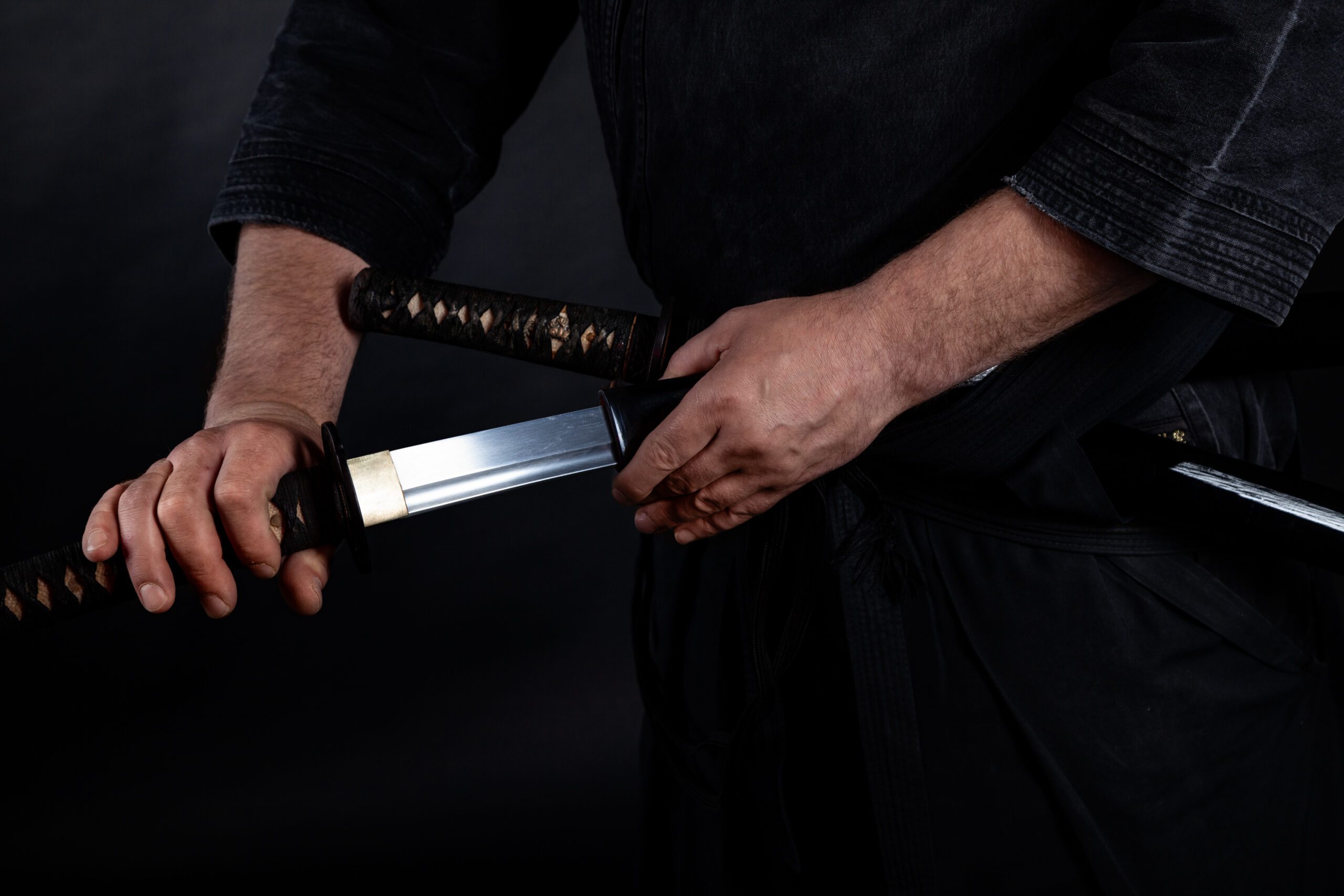
Chiburi (血振り) or “Bloodfall” is the symbolic representation of ending the encounter with teki (single or multiple) after their defeat. This is to represent the flinging of blood off of the blade before returning it to the Saya (鞘). In reality, when samurai would defeat an enemy, they would often carry rice paper to clean their blades after an encounter because Chiburi (血振り) by itself would not be enough to get all the blood off their blades. Before returning the Katana to its sheath, Samurai would make sure that the blade was clean. This was done to maintain the integrity of the blade, the saya, along with the cultural stigma regarding blood and its uncleanliness/impurity to a persons health and spirit.
Noto (納刀) or “Re-Sheathing” is the act of returning the Katana to its Saya/Sheath. Both of these together represent the literal techniques that exemplify Zanshin. The engagement has ended, and the samurai is disengaging from the situation. To do so safely and under guard is through Chiburi (血振り) and Noto (納刀). Maintaining your mind and awareness during this disengagement, through every action, making sure mindlessness does not present itself, is how to maintain the spirit of Samurai. This showcases that every action, until we fully disengage from the situation, (in most cases, through Kata (形)) – is performed with the same unwavering awareness. Not only does this showcase the mental discipline of technique, but it also highlights the practical implications for being completely aware within a specific situation. The technique ends, Zanshin (残心) does not.
Zanshin through Philosophy
Zanshin is a philosophy that extends far beyond an Iaidoka’s final cut. Outside of the dojo, the sword disappears, but Zanshin can be applied as an accent to each of our actions. Going back to its definition – Lingering Awareness – we begin to understand that Zanshin is the mind that remains after our actions. While this is similar to the broad idea of mindfulness, it is not the same. Zanshin keeps one present with intense disciplined mind during the course of ending an encounter. The intensity can even be greater than the cut that ended Teki (敵). The mind quietly continues, fully awake through each of our actions from the ending cut. Although the techniques seem ordinary or subtle, it is the formal end, that is beyond the supposed end of Teki (敵). It is not until we have concluded that there is no longer any danger, can we finally release ourselves from this element of Zanshin. In a way, the element of Zanshin never truly disengages. It can be present in many instances that extend beyond just the sword.
Like any spirited pursuit, there are levels to this understanding. We are all human, and this type of awareness requires years of training. No one can be completely attentive after an intense encounter, nor should that be the expectation. The purpose of Zanshin is not perfection of awareness after action, but the refinement of our focus. Little by little, day by day, we become more attentive to ourselves, to others and to the world around us. The dojo provides an ideal environment for cultivating this specific type of awareness. The mind requires a quiet place in which it can grow – a place free from distractions and surrounded by practices that that encourage discipline and focus. One of the foundational practices of Homonji is Mokuso (黙想) or short focused meditation. Meditation, in addition to other martial disciplines/Zen arts provide a vehicle through which the mind can travel to greater understanding.
At the end of training, it’s important to sit and reflect on the training that has occurred. Reflect on practice, reflect on our actions, reflect on our mind. This is an example of how Zanshin is utilized outside of the sword. Our training has concluded, therefore what is an echo to our actions? To close our training with Zanshin is a perfect way. All of our training can be treated as one performance or encounter, and the end of that encounter needs to be met with a deliberate awareness to all our actions. Mokuso (黙想) “meditation” after training provides a unique outlet to settle the mind. Essentially that is what Zanshin provides during the sequence leading up to ending the encounter. The mind settles, while it is aware of the entire landscapes of possibilities without attachment or stopping. Ultimately Zanshin can be understood as meditation carried beyond deliberate action.
Respectfully submitted by Bruno Sensei